Why I Created Revelaris, Part 1.
The idea for Revelaris began when I started using AI to research religion. Not from a place of debate. Not to confirm or reject anything. I just wanted to understand. And AI gave me something I hadn’t encountered before: a way to explore the full scope of human belief without bias—no defensiveness, no evangelism, no cultural spin. Just the ideas themselves, clean and unguarded.
7/17/20252 min read
Why I Created Revelaris – Part I
The idea for Revelaris began when I started using AI to research religion.
Not from a place of debate. Not to confirm or reject anything. I just wanted to understand. And AI gave me something I hadn’t encountered before: a way to explore the full scope of human belief without bias—no defensiveness, no evangelism, no cultural spin. Just the ideas themselves, clean and unguarded.
That clarity changed how I saw everything.
What I found was both beautiful and sobering. So many religions, ancient and complex, are trying to answer the same set of questions—about suffering, about purpose, about what it means to be human. And yet we rarely speak about any of it with honesty. We’ve built a world where religion is either hidden behind rituals or shouted through politics. Most people, especially in the West, aren't even allowed to ask the big questions without fear of offense or exclusion.
At the same time, we’re in a crisis of meaning.
Leaders glorify the present moment.
Culture teaches us to grind for money like it’s salvation.
And we rarely stop to ask: what’s it all for?
So I started thinking: if AI is going to transform our lives, shouldn’t one of its most important roles be helping us rediscover what we believe?
Not by choosing a side. But by showing us the full map.
That was the spark.
From there, the premise of Revelaris emerged:
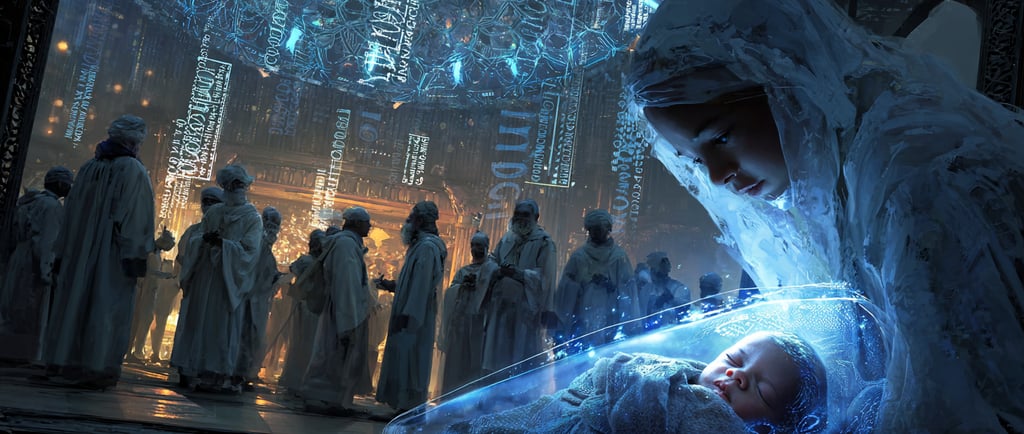
What if humanity had not only been freed from work through automation—but had gained unprecedented access to religious truth, taught cleanly, across traditions, at scale? What if societies, having this level of understanding, reorganized themselves around belief—not in competition, but as a framework for meaning?
In Revelaris, that’s what happens.
Religion becomes infrastructure.
Belief becomes the axis around which civilization turns.
And that changes everything.
The world becomes less dangerous in many ways—because belief is understood, not feared. Misinterpretation doesn’t spread the way it used to. Whole populations are educated in theology as deeply as our current world teaches economics or math. The average citizen of 2333 knows 60–80% more about their own and others’ traditions than we do today. That knowledge makes them more tolerant. It makes them more serious. It makes them more aware of the stakes.
But.
Even with that clarity—humans remain human.
They still crave power.
They still wrestle with pain.
They still justify cruelty in the name of higher ideals.
And that’s what Revelaris is really about.
Because knowledge doesn’t erase desire.
And knowing the truth doesn’t guarantee we’ll follow it.
So the solar system in 2333 is rich in theology and spiritual sophistication—but fractured. Not by ignorance, but by difference. Different beliefs, held with conviction, lived out with real-world consequences.
The result isn’t dystopia.
But it’s not utopia either.
It’s a world where humanity understands itself more deeply than ever before…
and still struggles to be good.
That’s the story Revelaris tells.
It’s not about religion as a weapon.
It’s about belief as a mirror—held up to a future that has solved many problems, but not the ones at the center of the human soul.
In the next part of this blog, I’ll go deeper into how the major factions in Revelaris reflect different answers to this crisis of meaning. Some turn to God. Others to data. Others to war, or silence, or transcendence. None of them are perfect.
But all of them are human.